

How Analyst Research Gets Everywhere
And Why It Matters More Than You Think
If you run a software or IT services company, the chances are that analyst firms like Gartner, Forrester, IDC and Info-Tech shape how your prospective customers find, evaluate, and shortlist technology vendors.
What’s less obvious is how that influence works. It is rarely a single report landing on a buyer’s desk. Analyst research travels through multiple channels, each reinforcing the other, and by the time a buying committee sits down to compare vendors, analyst thinking has often already framed the conversation and narrowed the field.
In this post, we explore the main routes through which analyst research reaches and influences enterprise buyers, what the data tells us about each channel, and what this means for tech companies who are not yet engaging with the analyst community.
Buyers Are Doing It for Themselves
Before we look at the channels through which buyers access research, it helps to understand the context in which it operates. This has changed abruptly in recent years, as enterprise technology buying has shifted decisively towards self-directed research.
According to Gartner’s own data, B2B buyers now spend only 17% of their total buying time in direct contact with vendors.
The rest, the other 83%, is spent gathering and evaluating information independently. A 2024 survey from TrustRadius found that 87% of B2B buyers choose to research product information on their own before they even speak to a sales representative, while McKinsey reports that they typically consult ten digital sources before making a purchase decision.
In this environment, the sources buyers rely on during this self-directed research phase carry enormous weight. Analyst research, because it comes from a position of perceived independence and broad market knowledge, has a privileged place in the information supply chain. There are mavericks and dissidents, but, according to one industry estimate, almost 75% of CIOs rely on research from analyst firms to inform their decisions, and nearly 72% of buying teams engage consultants or analysts at some point during the purchasing process (6sense, 2024).
The question for software and IT services firms is not whether analyst research matters. That’s beyond doubt. But what is often not fully understood is how it reaches out to influence buyers.
Figure 1: Analyst influence—direct and indirect routes (source: The Skills Connection)
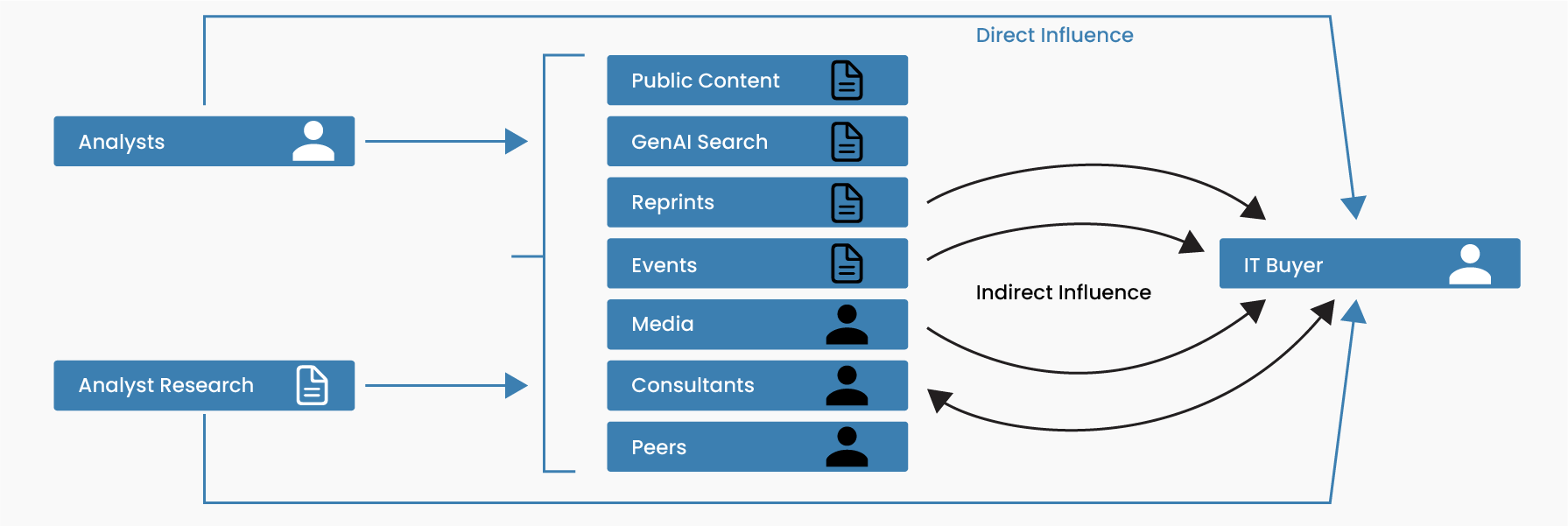
Route One: When Research Goes Straight to the Buyer
The main analyst firms run major conferences that attract thousands of technology buyers and decision-makers from around the world. Gartner’s IT Symposium/Xpo alone draws over 9,000 attendees, most of them CIOs, CTOs, and senior IT executives with active purchasing authority. Altogether, Gartner’s global conferences reach 75,000 attendees every year. Forrester and IDC run similar, though smaller, programs, as do many specialist analyst firms.
What makes these events significant, though, is not just their size but their timing. Attendees are typically in active planning cycles, setting technology budgets and evaluating vendor shortlists for the year ahead. When an analyst presents research findings on stage, it affects the way everyone in the room sees the market. Vendors who are well positioned in that analyst’s framework gain visibility at the exact moment buying decisions are starting to take shape. Vendors whose names are not mentioned are, by definition, not part of the picture.
- •
Free Published Content
Not all analyst research is hidden behind paywalls. Analyst firms publish significant amounts of freely accessible material, including blogs, podcasts, recorded webinars, social media commentary, and summary research pieces.
Gartner, for instance, publishes Hype Cycle summaries, Top Ten prediction lists, and sector overviews. Forrester’s analysts regularly publish opinion pieces and trend analyses on their blogs and across social platforms. Many smaller firms allow their research to be accessed publicly, making the content accessible by both readers and LLMs.
This public content serves as the top of the funnel for analyst influence. Buyers who are in the early research stage may come across a Gartner blog that’s trying to define a new market category or a LinkedIn post from Forrester that challenges common assumptions about a technology trend. That initial framing may well shape buyers’ research, including decisions about which vendors to consider and what criteria to use in evaluating them.
- •
Reprints
Analyst firms allow vendors to license and distribute research reports—commonly known as reprints. A firm that shows up well in a report like a Gartner Magic Quadrant, an Aragon Hot Vendors, or an IDC Innovator, can pay for the right to share that report with prospects and customers. Gartner claims its reprint program is a highly effective marketing tool for vendors, as it allows them to validate their market position with the help of objective third-party research.
Reprints matter. The prospect who downloads a Landscape reprint from a vendor’s website is also getting the benefit of the Forrester analyst’s market view and categorization framework. Vendors that are well positioned can use these reprinted reports to build credibility throughout the sales cycle, while competitors who are not there or are poorly positioned are at a disadvantage right from the start.
Route 2: Indirect Influence on Buyer Decisions
Beyond these three direct channels, there are several indirect channels that can influence buying decisions. Indeed, they are often more powerful, precisely because they are harder to see. When analyst thinking arrives via a more indirect route, buyers will often absorb it without necessarily recognizing where it originated.
- •
GenAI Searches
This is the newest and fastest-growing channel through which analyst research makes its presence felt. When buyers use AI-powered search tools—Google’s AI Overviews, ChatGPT, Microsoft Copilot or the Perplexity ‘answer engine’—to research technology categories or compare vendors, the underlying models draw heavily on published analyst research. A 2025 TrustRadius study found that more than 70% of B2B buyers encountered Google’s AI Overviews during the research process, and 90% clicked through to at least one cited source. Separately, 6sense found that 94% of buyers now use large language models in reaching buying decisions.
The practical consequences are obvious. If analyst firms have published research that positions you favorably, that positioning is likely to surface when buyers ask AI tools questions like ‘What are the leading vendors in [your category]?’ or ‘How does [your product] compare with [a competitor’s]?’ If analyst research does not mention your company at all, or positions it poorly, the same dynamic works against you. GenAI search has expanded the reach of analyst research far beyond the research firms’ own subscriber bases.
- •
Industry Media
Technology journalists and trade publications routinely cite analyst research. When journals like TechCrunch, The Register, CIO Magazine, or Computer Weekly cover a market trend or vendor comparison, they will often refer to insights from relevant analysts. This happens both in dedicated coverage of analyst reports and in broader feature articles, where analyst data lends weight and authority.
For buyers who are not analyst firm subscribers, which includes most small and mid-market companies, media coverage is frequently the main exposure to analyst thinking. Not showing up in the analyst-sourced narratives in the articles and newsletters technology buyers read day by day and week by week means reduced visibility in a channel that’s often relied on to provide unbiased facts and opinion.
- •
Consultants and Systems Integrators
Management consulting firms and systems integrators are heavy consumers of analyst research. When Deloitte, Accenture, or PwC teams advise enterprise clients about their technology options, they regularly use analyst frameworks to support their recommendations.
According to 6sense’s 2024 research, more than 70% of buying teams bring in external consultants or analysts to help with their purchasing decisions. The involvement of these consultants leads to larger buying groups (averaging 12.9 people versus 6.4) and longer buying cycles (13.6 months versus 6.5), which may suggest more thorough evaluation processes, with analyst research playing a structuring role.
The consultants and SI channel is especially significant for the largest deals. Enterprise buyers spending six or seven-figure sums on technology purchases seldom make their decisions without some form of advisory input—not least because of their understandable wish to cover their backs in case things go wrong.
That advisory input is almost always backed up by analyst research. But if your company does not show up on the analysts’ radar, it is unlikely to be visible to the consultants who are advising your target customers.
- •
Peer Networks and Word of Mouth
Enterprise technology buyers talk to each other. According to a 2024 Wynter study, nearly three out of four B2B marketing executives rank word-of-mouth and peer recommendations as the most important factors in deciding which vendors to consider.
TrustRadius research has found that 56% of all buyers choose to talk to existing product users before purchasing. And that figure rises sharply, to 71%, for enterprise-scale purchases.
Not all buyers, however, have the contacts to make this happen. The next best thing for enterprises, and the opportunity to sample the opinions of large numbers of buyers with slightly different experiences and use cases, is provided by platforms such as Gartner Peer Insights (enterprise buyers exclusively), G2, TrustRadius or PeerSpot. Many buyers place a lot of value on the unfiltered customer reviews of relevant products they find in such platforms, with Peer Insights having the extra value-add of the Gartner brand.
What connects peer influence to analyst research more broadly is language. When CIOs are recommending a vendor, they tend to talk in terms of the frameworks and categories the analyst firms have established. Expressions like ‘They were named a Cool Vendor by Gartner’ or ‘Info-Tech rates them very highly for customer experience’ are part of the shorthand of these conversations. The analysts’ work creates the shared vocabulary buyers use to compare notes and validate their choices. As a result, these analyst-influenced frameworks become the common reference point, even in conversations where no analyst report is actually mentioned.
It’s a Compound Effect
Ultimately, what makes analyst research so influential is the way the various channels reinforce each other.
Buyers might first encounter your category through a Gartner blog article, and then see a media article citing the same Gartner research. When they ask ChatGPT about vendors in this space, the response they get is likely to be informed by published analyst reports. They’ll probably look on Gartner Peer Insights next and see a range of reviews for different vendors. And when their chosen consultant presents a shortlist that mirrors the vendors listed in Gartner’s Market Guide and a respected industry colleague adds a personal recommendation using the same kind of language the analysts used, they are probably justified in feeling that much of the risk has been taken out of the decision.
By the time buyers come to evaluate specific vendors, analyst-originated thinking has almost always shaped their understanding of the market. A recent Forrester study revealed that 92% of B2B buyers have at least one supplier in mind before they even start their journey. And research from 6sense has found that in 19 cases out of 20 the winning vendor’s name is already there, written down on the buyer’s initial shortlist.
So what is the factor that has determined that original shortlist? In enterprise technology markets, the answer, almost always, is analyst research.
How Does All This Play Out for Tech Companies?
If your company is not engaging with analyst firms, you are not just missing out on a single marketing channel. You are absent from the system that actually shapes how enterprise buyers discover, categorize, and shortlist vendors across multiple touchpoints. Research does not stay where it tends to start off, inside the analyst firm’s subscriber portal. It flows outward in many different directions, through events, public content, reprints, AI search results, media coverage, consultant recommendations, and peer conversations.
For software firms and IT services companies that are new to analyst relations, the starting point is understanding how this dissemination system works.
Knowing how analyst research travels through these channels—and how each channel reinforces the others—changes the calculation about whether to invest in analyst engagement, and when and how to go about doing it.
The recipe for success is surprisingly straightforward. Contrary to popular myth, it is not about paying to get good reviews. It is simply about putting in the effort to make sure that when the analysts write about your market, they understand what your company does and where it fits in.
Firms that do this well find that analyst engagement pays back across their entire go-to-market effort. They benefit, again and again, because of the compound effect of being present and active in an analyst-led ecosystem that buyers trust and rely on when it comes to making key decisions.
Sources and Data References
Gartner (2024) – B2B buyers spend only 17% of buying time in direct vendor contact
TrustRadius (2024) – 87% of B2B buyers prefer independent research before engaging sales
McKinsey – B2B buyers consult an average of 10 digital sources before purchase decisions
6sense (2024) – 72% of buying teams involve consultants or analysts; 94% of buyers use LLMs
6sense (2025) – 95% of the time, the winning vendor was on the buyer’s day-one shortlist
TrustRadius (2025) – 72% of buyers encountered AI Overviews during research; 90% clicked through
Forrester (2024) – 92% of B2B buyers start with at least one vendor already in mind
Wynter (2024) – 73% of B2B marketing execs rank word-of-mouth as the most influential factor
Gartner – Over 75,000 conference attendees annually; 500,000+ client inquiries per year
Starsight / Kea Company – Analyst firm revenue and analyst count data